
Social media advertising has evolved dramatically over the past decade. What once worked with simple organic posts and minimal paid promotion is no longer sufficient. Today, businesses face intense competition for attention on platforms like Facebook and Instagram, where algorithms prioritize relevance, engagement quality, and user intent. In this environment, how you advertise matters just as much as how much you spend.
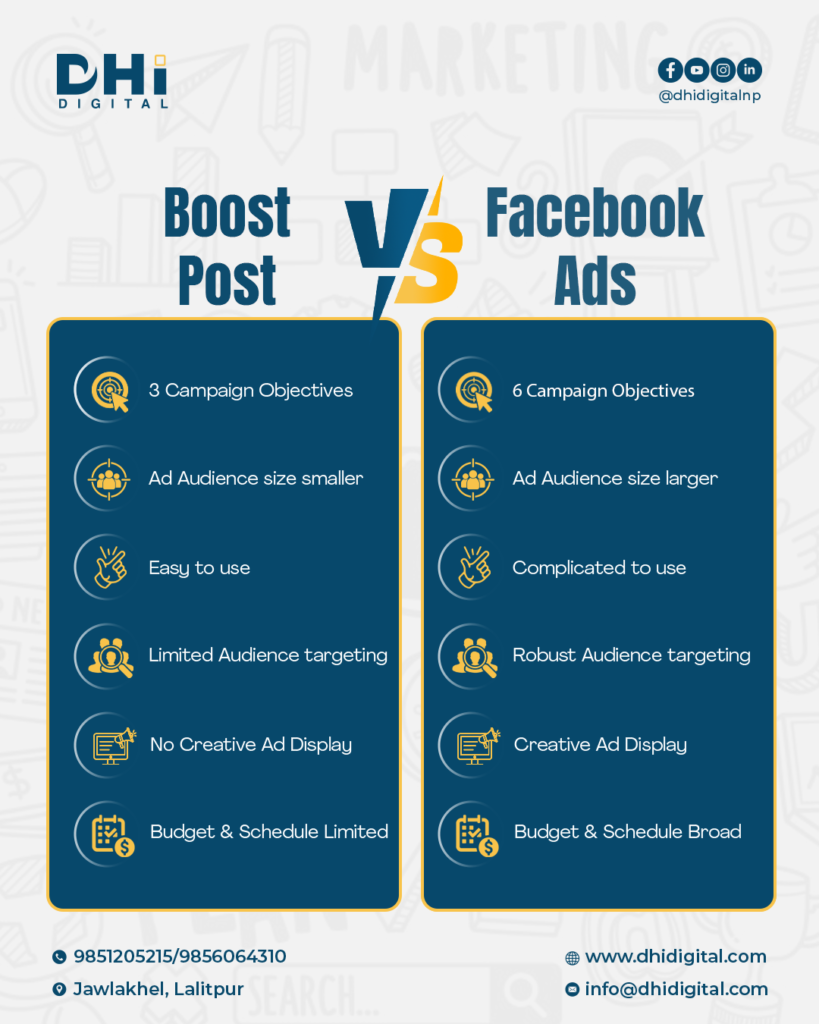
Boost Post or Facebook Ads: A Critical Decision for Businesses
One of the most common decisions businesses face is whether to use Boost Posts or invest in Facebook Ads through Ads Manager. On the surface, both options promise visibility and engagement. Many businesses assume they are interchangeable. In reality, they serve very different purposes and produce very different results.
In 2026, when advertising costs are rising and performance expectations are higher than ever, choosing the wrong option can lead to wasted budget, missed opportunities, and stalled growth. This blog provides a detailed breakdown of Boost Posts and Facebook Ads, explains how each works, and helps you determine which option is the smarter choice for sustainable business growth.
Understanding Meta’s Advertising Ecosystem
Meta offers businesses two primary ways to pay for exposure on Facebook and Instagram:
- Boost Posts : A simplified promotion tool focused on increasing reach and engagement
- Facebook Ads : A full-scale advertising system designed for performance and scalability
Although both appear under the same platform, they are built for entirely different levels of marketing maturity. Boost Posts are designed for speed and convenience. Facebook Ads are designed for strategy, control, and measurable outcomes.Understanding this distinction is essential before allocating your advertising budget.
What is a Boost Post?
A Boost Post allows you to promote an existing post from your Facebook or Instagram Page by paying to increase its reach. This option is directly accessible from your Page and requires minimal setup.
Common Uses of Boost Posts
Boost Posts are typically used to:
- Increase likes, comments, and shares
- Promote announcements or updates
- Highlight offers or events
- Improve visibility of organic content
- Engage existing followers
Because they are quick and easy to launch, Boost Posts are popular among small businesses and beginners. However, ease of use comes at the cost of functionality.
Limitations of Boost Posts
Boost Posts are primarily optimized for engagement, not for business results. They do not support:
- Conversion tracking
- Advanced audience targeting
- Retargeting website visitors
- Lookalike audiences
- Funnel-based marketing
As a result, Boost Posts often produce vanity metrics likes and comments that look good but do not directly translate into leads or sales.
What are Facebook Ads?
Facebook Ads are created through Meta Ads Manager, which offers a comprehensive advertising system designed to support business growth at every stage of the customer journey.
Rather than promoting a single post, Facebook Ads allow businesses to create structured campaigns aligned with specific objectives.
What Facebook Ads Enable Businesses to Do.
Facebook Ads allow businesses to:
- Generate leads at scale
- Drive traffic to websites or landing pages
- Sell products through conversion campaigns
- Retarget users who have already shown interest
- Build lookalike audiences based on customer data
- Test creatives, audiences, and messaging
- Scale campaigns systematically
Although Facebook Ads require more planning and expertise, they provide significantly more control and long-term value.
Campaign Objectives: Engagement vs Results
Boost Posts offer limited objectives focused mainly on awareness and engagement. These objectives are not designed to optimize for revenue-generating actions. Even when a Boost Post receives high engagement, there is no guarantee that users are likely to convert.
Facebook Ads provide advanced, goal-based objectives including awareness, traffic, leads, engagement, app installs , sales and conversions. Each objective trains Meta’s algorithm to deliver ads to users most likely to complete a specific action. This optimization is one of the most powerful advantages of Facebook Ads and a key reason they outperform Boost Posts in growth-focused campaigns.
How Audiences Reach Differs Between Boost Posts and Facebook Ads?
Boost Post Audience Reach
Boost Post typically targets page followers, friends of followers and broad interest based on audiences. This approach limits reach to people who are already familiar with your brand or loosely match general interests. It is not designed for consistent customer acquisition.
Facebook Ads Audience Reach
Facebook Ads allow businesses to reach new customers at scale, target high-intent users and advertise locally, globally. Advanced features such as custom audiences, lookalike audiences and behavioral targeting make Facebook Ads far more scalable and effective for customer acquisition.
Targeting Accuracy: General vs Precise
Boost Posts offer basic targeting options such as age, gender, location, and interests. They do not support behavioral targeting or customer data integration.
Facebook Ads provide precise targeting based on website activity, purchase behavior, video views, engagement history, customer data.This level of accuracy reduces wasted ad spend and improves return on investment.
Creative Control and Optimization
Boost Posts restrict advertisers to existing content and do not support A/B testing. This limits experimentation and optimization.
Facebook Ads allow full creative flexibility, including dark posts, multiple ad formats, and split testing. Creative testing is critical for identifying winning ads and scaling campaigns successfully.
Budget Management and Cost Efficiency
Boost Posts operate with fixed budgets ,limited scheduling options, no bidding control. Advertisers cannot adjust bidding strategies or optimize cost-per-result.
Facebook Ads offer Daily or lifetime budgets, Advanced bidding strategies, Cost-per-click or cost-per-conversion optimization, Automated budget allocation. These features help businesses manage spend efficiently and maximize return on investment.
Analytics, Tracking, and Performance Measurement
Boost Posts provide only surface-level insights such as reach and engagement. They do not track conversions or ROI.
Facebook Ads provide detailed analytics, including conversion tracking, funnel analysis, audience insights, and cost metrics. This data-driven approach enables continuous improvement and informed decision-making.
Scalability: Short-Term Reach vs Long-Term Growth
Boost Posts are suitable for short-term exposure but lack scalability. Increasing spend does not guarantee improved results.
Facebook Ads are built for growth. Successful campaigns can be expanded by increasing budgets, refining targeting, and improving creatives without losing performance.
The Hidden Cost of Choosing the Wrong Option
Many businesses rely on Boost Posts because they appear cheaper and easier. However, the long-term cost of missed leads, lost sales, and inefficient targeting often outweighs the perceived savings. In competitive industries, this opportunity cost can significantly impact growth.
Common Mistakes Businesses Make
Businesses often rely too heavily on Boost Posts due to convenience. Others run Facebook Ads without proper objectives or tracking. Both approaches limit results. Successful advertising requires clarity, structure, and data-driven execution.
Building a Sustainable Advertising Strategy
The most effective approach combines organic content, Boost Posts for visibility, and Facebook Ads for performance. However, Facebook Ads should form the foundation of any growth-focused strategy. This balanced approach ensures both brand awareness and measurable results.
The Future of Paid Social Advertising
In 2026, algorithms prioritize relevance, data quality, and user intent. Businesses that rely on basic promotion tools will struggle to compete.
Facebook Ads provide the flexibility and intelligence required to adapt to changing platform dynamics and consumer behavior.
When Boost Posts Still Make Sense
Boost Posts can still be useful in specific situations, including:
- Promoting announcements, updates, or events that require quick visibility
- Highlighting organic posts that are already performing well
- Increasing likes, comments, and shares among existing followers
- Maintaining brand presence on social media pages
- Supporting short-term engagement goals
However, Boost Posts are limited in targeting, tracking, and scalability. They are best used as a supporting tool rather than a primary growth strategy. For measurable results such as leads or sales, Boost Posts should complement performance-driven Facebook Ads instead of replacing them.
The Right Strategy for Long-Term Growth
Boost Posts and Facebook Ads serve different purposes. Boost Posts offer convenience and engagement, while Facebook Ads deliver structure, scalability, and measurable ROI.For businesses serious about sustainable growth in 2026 and beyond, Facebook Ads are the smarter long-term investment. Boost Posts can support visibility, but real growth comes from performance-driven advertising.For further insights on digital marketing strategy, paid advertising, and performance-driven growth solutions, visit DHi Digital.